Assess and monitor welfare, species by species
A common method, adapted to each species, to target priority actions and measure their effect.
Welfare, a state specific to each animal
A protocol adapted to each species
The Animal Welfare Monitor protocol is based on the Five Domains model and on the Welfare Quality® method (Blokhuis, 2008), adapted to zoo species (Romain et al., 2026):
- Factual, illustrated questions
Questions are descriptive and come with images and videos, so that everyone answers in the same way.
- Species-specific answers
The answers offered differ depending on whether it is a golden lion tamarin, an okapi or a vulture.
- A comparative approach
Knowing whether what you observe is usual for a species requires reference values: assessments are therefore repeated with the same protocol, and the results compared with the literature.
- Ready-made assessments
More than 100 species are covered: mammals, birds, fish, reptiles.
- Scientific collaborations
Depending on the project, we work with scientists from other organisations: CNRS, INRAE, universities, veterinary schools.
Two complementary perspectives
The protocol combines a questionnaire and behavioural observations. Observations focus on one individual (focal sampling) or on all the individuals in a group (scan sampling), live or on video.
- What the environment allows
The questionnaire covers the living environment and practices: it assesses whether the environment provided allows the animal to express what it needs. Around a hundred questions cover housing, feeding, health and behaviour.
- What the animals do
Observations show how each individual uses its environment and which behaviours it expresses; some are indicators of positive welfare, others of poor welfare. These behaviours are grouped in ethograms (lists of named, described and illustrated behaviours, specific to each species).
From assessment to action, with the whole team
Keepers, vets, biologists, education team, management: everyone has a place in the process. Six steps that form a cycle of continuous improvement.
- 1
Identify the species to monitor first
The free rapid assessment gives an overview and highlights the groups to keep an eye on.
- 2
Assess living conditions
In the field, the team fills in the species-specific questionnaire from the mobile app.
- 3
Observe behaviour
Observations complement the questionnaire and show what the animals actually do day to day.
- 4
Analyse the results
The team interprets the results in the light of what is known about the species. This work can be done on your own or with our ethologists.
- 5
Decide on actions and assign them
You set the objectives and actions, then assign each action to a team member, with a deadline. Everyone finds their own tasks in the app.
- 6
Measure the effect of actions
By repeating assessments, you follow how the results change: welfare becomes continuous monitoring, not a one-off snapshot.
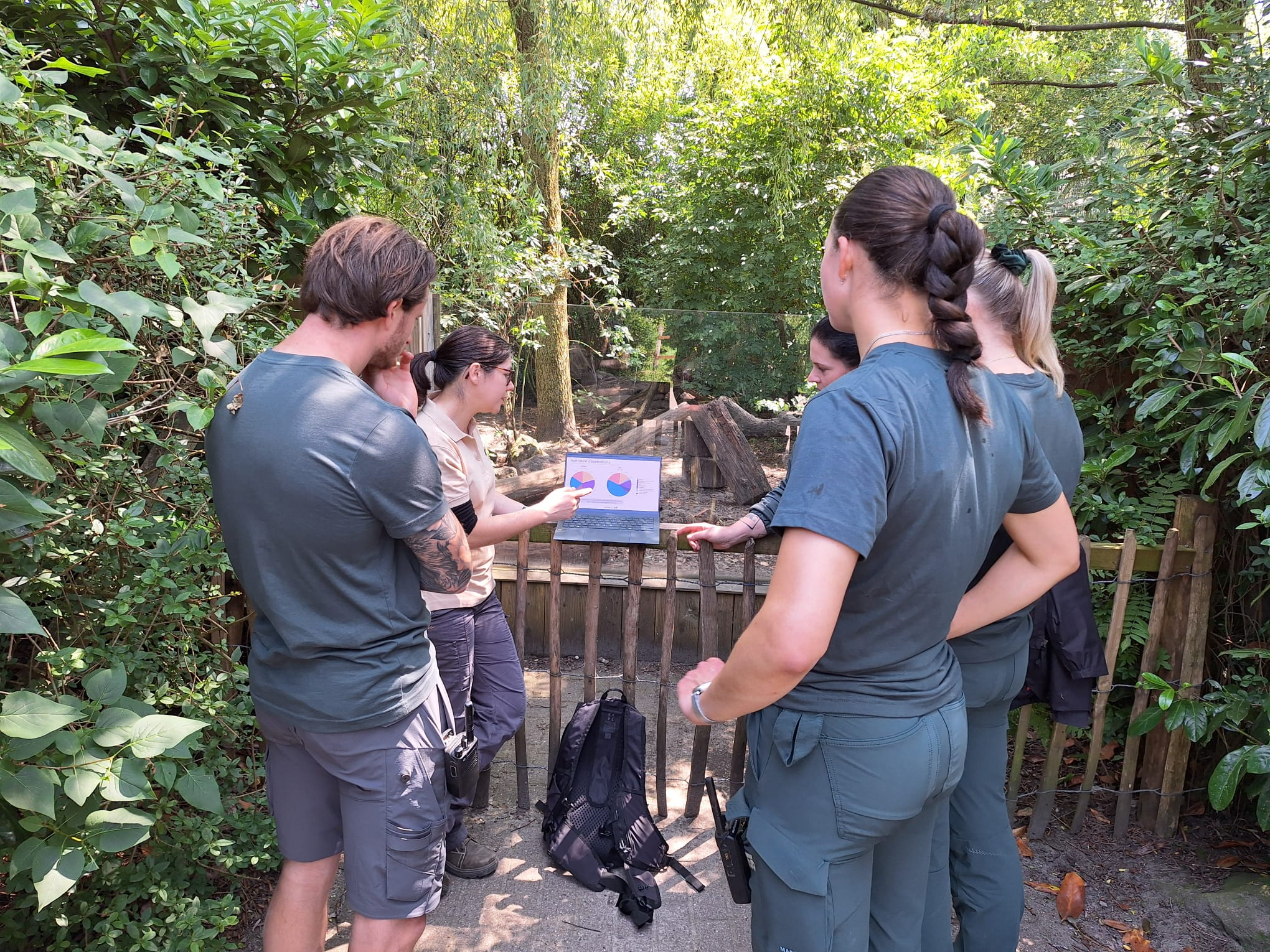
Tools for the field and for analysis
Akongo has developed Animal Welfare Monitor, an app used in the field and on the web, with the same data:
- In the field
Your teams fill in questionnaires, carry out observations and add notes and photos from a phone or tablet, on Android or Apple. The app works without a network: data is sent once the connection is back.
- On the web, for analysis
The web version presents the results as charts and dashboards, for each individual and each group, with how they change over time.
- Shared resources
Questionnaires and ethograms, designed by Akongo's scientific team, can be consulted in the field and on the web.
- Exportable data
In every offer, you export your data in .csv or .xls format.
The expertise of our ethologists and vets, when you need it
All our offers can be used on your own or with support. In both cases, we train your animal welfare leads in using the tool; they then train the rest of the team. The aim is for your teams to lead the assessment and improvement of their animals' welfare themselves.
With support, invoiced separately, our team works through the process alongside you:
- Scientific and methodological advice
Analysis of your data, design of specific protocols, species-specific recommendations, literature monitoring.
- On-site support
Regular days at your facility, working with the teams, putting actions in place and following up on practices.
- Action follow-up
Follow-up reports, recommendations, objectives and action plans defined with your teams.
- Team training
On-site or remote sessions with hands-on workshops: welfare assessment, use of the tools, observation methodology, interpretation of results.
- Collaborative research projects
Eligible for the French Research Tax Credit (Crédit d'Impôt Recherche) for facilities taxable in France.
Structure the welfare monitoring of your animals
Scientific references
- Blokhuis, H. J. (2008). International cooperation in animal welfare: The Welfare Quality® project. Acta Veterinaria Scandinavica, 50(Suppl. 1), S10.
- Mellen, J., & MacPhee, M. S. (2001). Philosophy of environmental enrichment: Past, present, and future. Zoo Biology, 20(3), 211-226.
- Rault, J. L., Bateson, M., Boissy, A., Forkman, B., Grinde, B., Gygax, L., … Jensen, M. B. (2025). A consensus on the definition of positive animal welfare. Biology Letters, 21(1), 20240382. https://doi.org/10.1098/rsbl.2024.0382
- Romain, A., Briard, L., Leroutier, G., Parker, M., Chenet, B., Wagner, C., Petry, A., & Quintard, B. (2026). Animal Welfare Monitor: Raising the bar for species-specific welfare evaluation using Welfare Quality® principles. Animals, 16(5), 842. https://www.mdpi.com/2076-2615/16/5/842
Learn more about our solutions
- Implementation
Discover our offers for monitoring your animals' welfare.
- Tools
Explore our comprehensive range of tools optimised for managing and analyzing animal welfare data.