Enrichment module — document, track, evaluate
- Visual catalogue
- Tracking by sector
- Objective evaluation
Document and track your enrichments
Build a shared library of your enrichments and follow each one, from creation to removal, with full traceability.
- Photographic catalogue
Each enrichment is documented with one or more photos, its attributes (type, materials, targeted behavioural objectives) and, if needed, stock management. Together they form a shared reference for the whole team.
- Distribution by zone
Record each distribution by sector, with date, location and traceability photos. You know exactly which enrichment was offered, where, when and to which animals.
- Calendar view
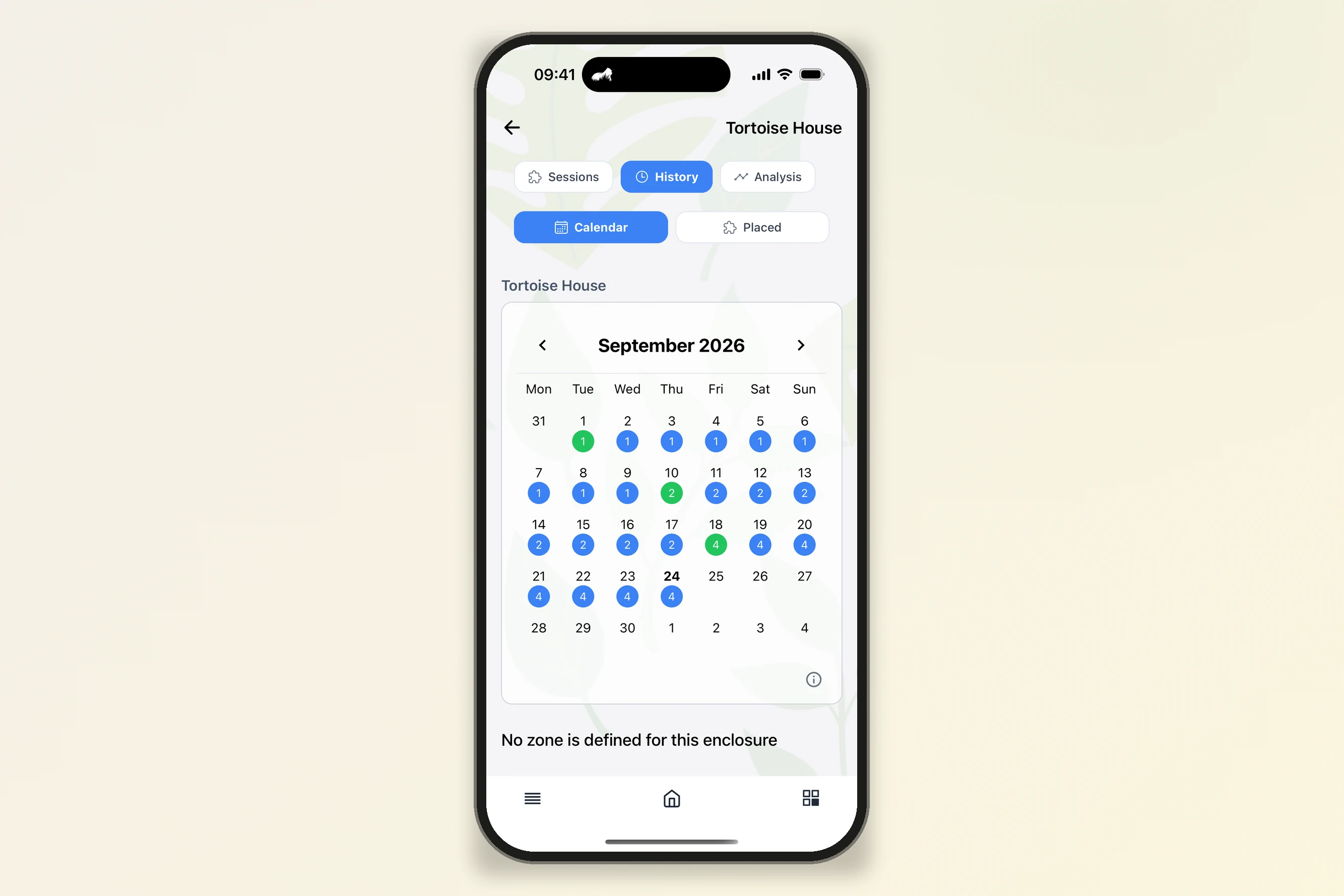
Quickly find, over any period, which animals received which enrichments — with history and photos. Useful for preparing a report or spotting a neglected sector.
- Removal management
Schedule the removal of each enrichment: manually, after a set installation period, or on a specific date. Tracking stays complete, from setup to removal.
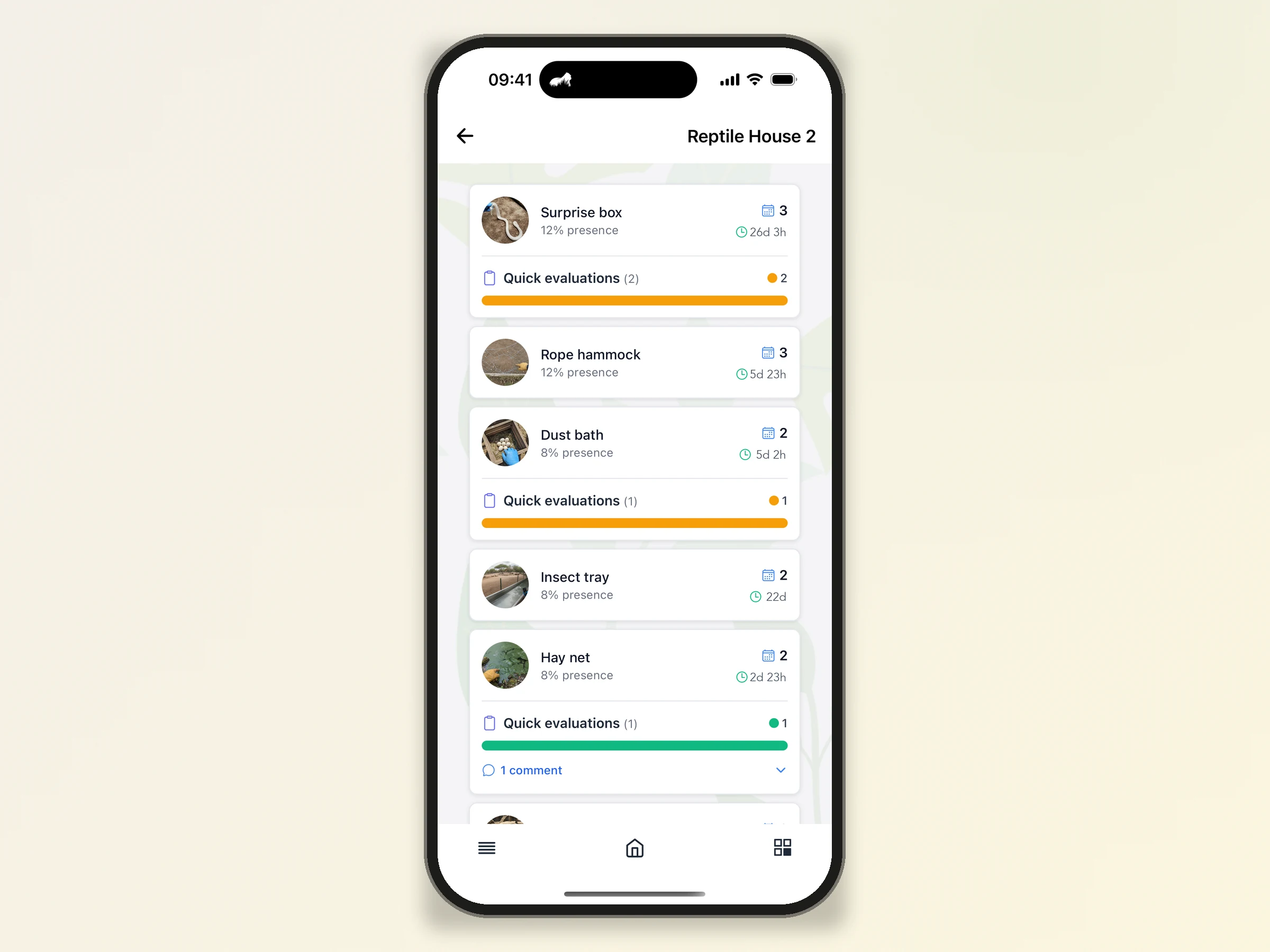
Two levels of reading
For keepers, day to day
For an overview
Plan rotations, follow the calendar
The calendar provides a monthly view by sector and enclosure, colour-coded for additions, removals and presence, for immediate reading. You see at a glance what is in place, what is due for rotation and what is missing.
- Monthly view, by sector and enclosure
A calendar colour-coded by additions, removals and presence: what is in place, what is due for rotation, what is missing — without cross-referencing several sources.
- Tracking diversity
Check that each enclosure regularly receives varied enrichments, covering the main categories: feeding, sensory, cognitive, social and physical.
Why evaluate enrichment?
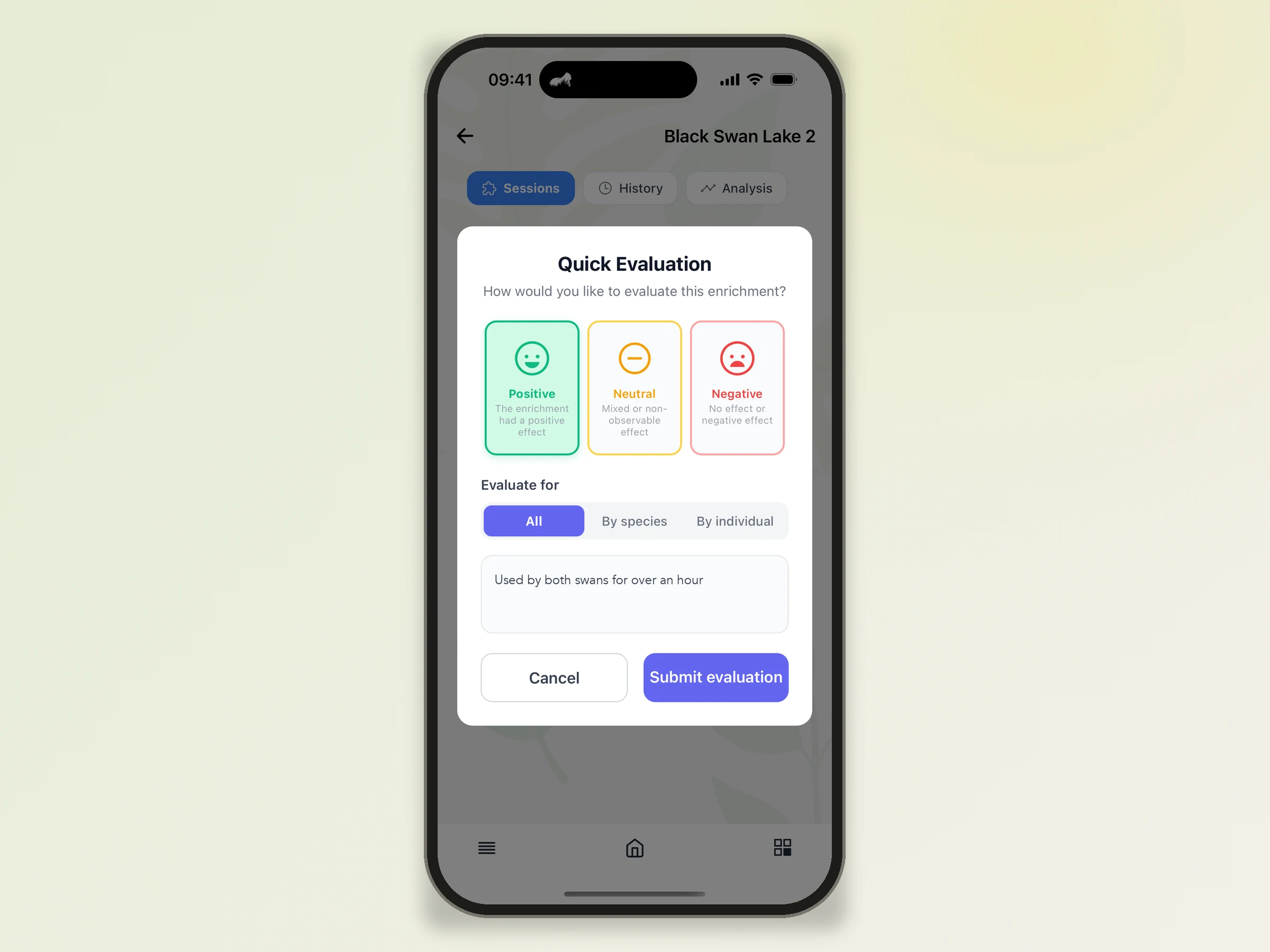
An enrichment does not always achieve the intended effect: a device may be ignored, used differently than planned, or lose interest over time. Evaluating it checks whether the behavioural objectives were met — encouraging the species' natural behaviours, reducing undesirable behaviours such as stereotypies — and guides the next proposals. In the module, evaluation is modular:
- Quick evaluation
A short questionnaire at removal, to note the animal's interest and whether the objective was met.
- In-depth evaluation
An analysis at enclosure, species or individual level, cross-referenced with behavioural observations.
- Tracking over time
By repeating evaluations, you compare results and measure the real effect of the changes made.
A proven method: the S.P.I.D.E.R model
Evaluating enrichment relies on a structured approach. The module follows the S.P.I.D.E.R framework, developed to integrate enrichment into the daily management of zoos and aquariums (Mellen & MacPhee, 2001). Six steps, designed as a continuous-improvement cycle:
S — Setting
Define the behaviours to encourage for the species and the individual, based on its natural history and needs.
P — Planning
Choose and prioritise enrichments by their value to the animal and their feasibility (cost, enclosure constraints).
I — Implementing
Distribute enrichments in the field and record the distribution (sector, date, animals involved).
D — Documenting
Trace each distribution (photos, date, location) and the related observations, for a reliable history.
E — Evaluating
Measure whether objectives are met, from observations and quick or in-depth evaluations.
R — Re-adjusting
Adjust proposals based on results, then start the cycle again: enrichment becomes ongoing monitoring.
Measure diversity and demonstrate impact
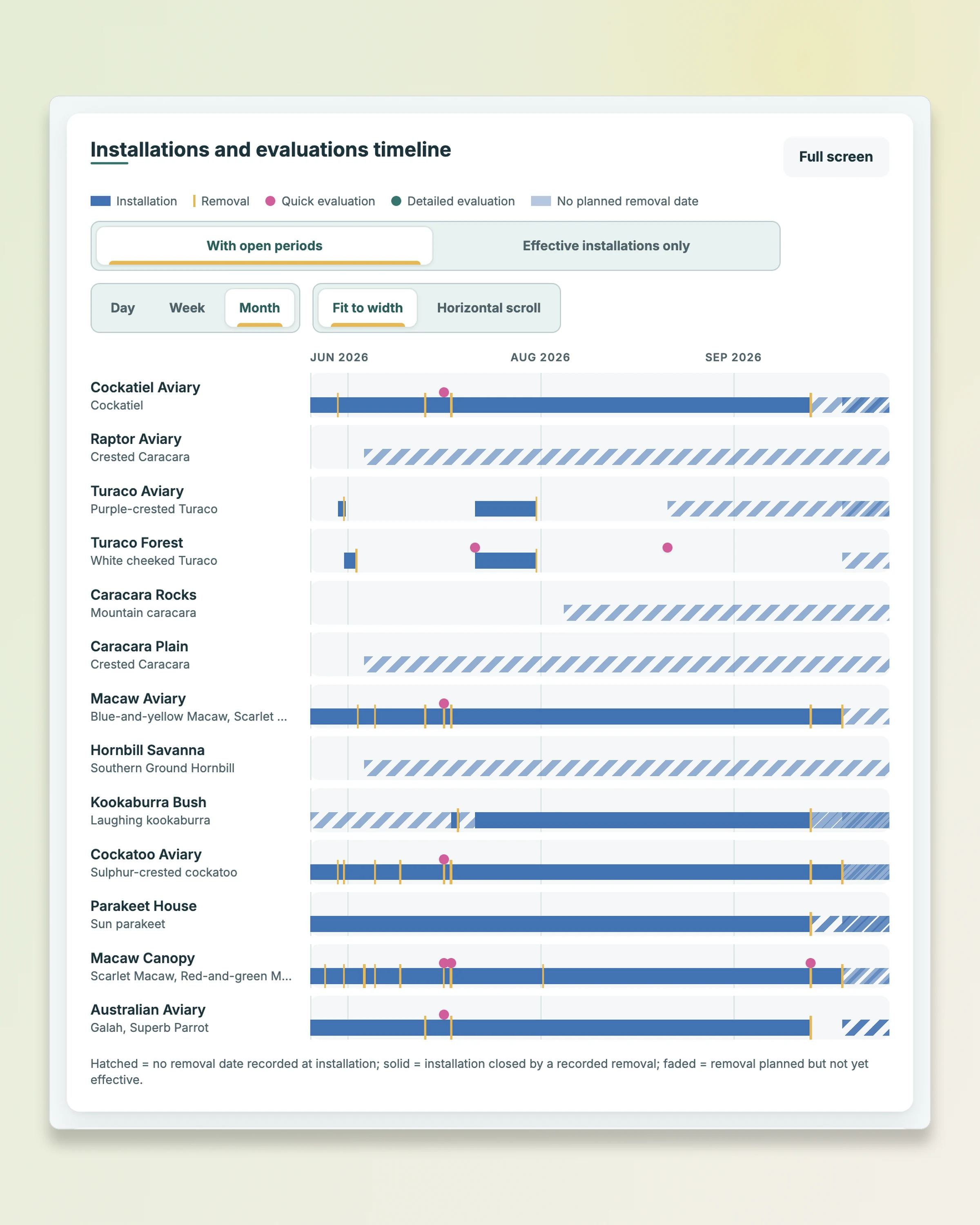
Analysis goes beyond simple counting. On the phone, the history traces installations and removals, and the Analysis tab shows each enclosure's enrichment diversity and combinations. On the web, on a computer, you also track progress towards your diversity and frequency objectives:
- Timeline
On the web, chronologically retraces all enrichment activity.
- Diversity index
On the phone and on the web, an index measures coverage across the different enrichment types.
- Distribution and routine
On the web, visualise distribution and usage habits to spot rhythms and the enrichment combinations that work best together.
- EAZA-format PDF report
Generated from the web version, a complete document to attach to your EAZA or AZA accreditation files: a formal record of your whole programme, ready for an audit.
A tool that adapts to your options, in practice
Every facility manages its enrichment its own way. The module sets on a continuum, from quick documentation to advanced evaluation: you enable only what you need.
The enrichment module is available in the "Progress" offer.
Mellen, J., & MacPhee, M. S. (2001). Philosophy of environmental enrichment: Past, present, and future. Zoo Biology, 20(3), 211–226. https://doi.org/10.1002/zoo.1021 · animaltraining.org/spider
Learn more about our solutions
- Tools
Explore our comprehensive range of tools optimised for managing and analyzing animal welfare data.
- Training
Discover our training organisation and develop your expertise in ethology and animal welfare.